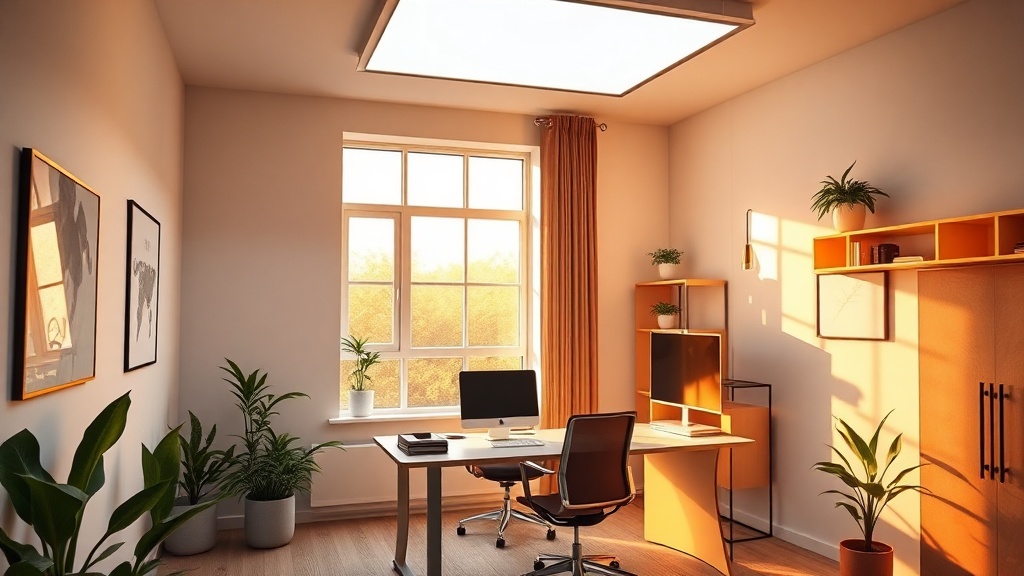
Circadian Lighting Home Office: Spring Refresh to Boost Focus

Hook: The clock jumps forward, the sun rises earlier, and your office lights stay stubbornly the same. What if you could make your home office follow the sun’s rhythm, keeping you sharp and stress‑free all day?
Why does daylight saving time matter for your workspace?
When DST starts, we lose an hour of sleep and our bodies get a jolt. Research shows that abrupt changes to light exposure can disrupt circadian rhythms, leading to fatigue, reduced concentration, and even mood swings. Our previous DST guide explained the outdoor impact; now let’s bring that insight inside.
What is circadian lighting and how does it work?
Circadian lighting uses tunable LEDs that adjust color temperature and intensity throughout the day, mimicking natural sunlight. In the morning, light is cooler (5000‑6500K) to signal wakefulness; midday light shifts to a balanced white (4000‑4500K); in the evening, warmer tones (2700‑3000K) cue your body to wind down. By aligning indoor light with these phases, you support melatonin regulation and keep your brain alert when you need it.
Which smart fixtures are best for a home office?
Here are three reliable options that work well with popular voice assistants and home automation platforms:
- Philips Hue White & Color Ambiance – Offers 16‑million colors, easy app control, and integrates with Apple HomeKit, Google Assistant, and Alexa.
- LIFX Z LED Strips – Ideal for desk edges or wall accents, with built‑in scheduling and no hub required.
- Nanoleaf Shapes – Modular panels that double as decorative art while delivering precise color temperature shifts.
All three allow you to set “sunrise” and “sunset” schedules that automatically adjust on the DST change.
How to set up a circadian lighting routine in 5 steps
- Map your daylight pattern. Use a simple chart: sunrise (6 am), midday (12 pm), sunset (6 pm). Adjust for your local DST shift.
- Choose fixtures for the main work zone. Place a tunable panel above your desk (e.g., a Philips Hue ceiling light) and add a bias light behind the monitor.
- Program a schedule. In the Hue app, set “Morning” to 5000K at 7 am, “Day” to 4000K at 10 am, “Evening” to 3000K at 5 pm. Enable the DST toggle so the schedule shifts automatically on the second Sunday in March.
- Integrate with your workflow. Use IFTTT or Home Assistant to dim lights when you start a video call, or to boost brightness during focus blocks.
- Test and tweak. After a week, note any eye strain or fatigue. Slightly adjust temperature or intensity until you feel “in sync” with the daylight.
What are the productivity benefits?
Studies from the Lighting Research Center show that circadian‑aligned lighting can increase task‑completion speed by up to 15 % and reduce self‑reported fatigue by 20 %. For hybrid workers, this means sharper video‑call presence and fewer mid‑day slumps.
How does this fit into a broader spring refresh?
Beyond lighting, consider these quick wins that complement your new setup:
- Swap heavy curtains for light‑filtering blinds that let natural daylight in while reducing glare.
- Refresh your desk ergonomics – a standing desk paired with proper lighting reduces neck strain.
- Introduce a few low‑maintenance plants (e.g., snake plant, pothos) that improve air quality and add a touch of nature.
For a full home‑office makeover, see our Multi‑Functional Home Office Nook guide.
What are common pitfalls and how to avoid them?
- Over‑bright evening light. Keep evening settings below 300 lux to protect melatonin production.
- Ignoring natural light. Position your desk near a window and use blinds to balance indoor LEDs with outdoor sunshine.
- Complex schedules. Start simple – a two‑step morning/evening routine is better than an overly intricate program.
Takeaway
Adjusting your home office lighting to follow the sun’s natural rhythm is a low‑cost, high‑impact spring refresh. With tunable LEDs, smart scheduling, and a few ergonomic tweaks, you’ll ride the DST change smoothly, stay focused, and feel better throughout the day.
Related Reading
- Backyard Lighting Guide: Bright Ideas for Every Spot in 2026 – Explore lighting options for outdoor spaces.
- Bio‑Harmony: Align Your Meals with Your Body Clock for Peak Performance – Pair lighting with nutrition for full circadian health.
- Spring Forward: How Daylight Saving Time Impacts Your Backyard Routine & Energy Use – Understand DST’s broader effects.