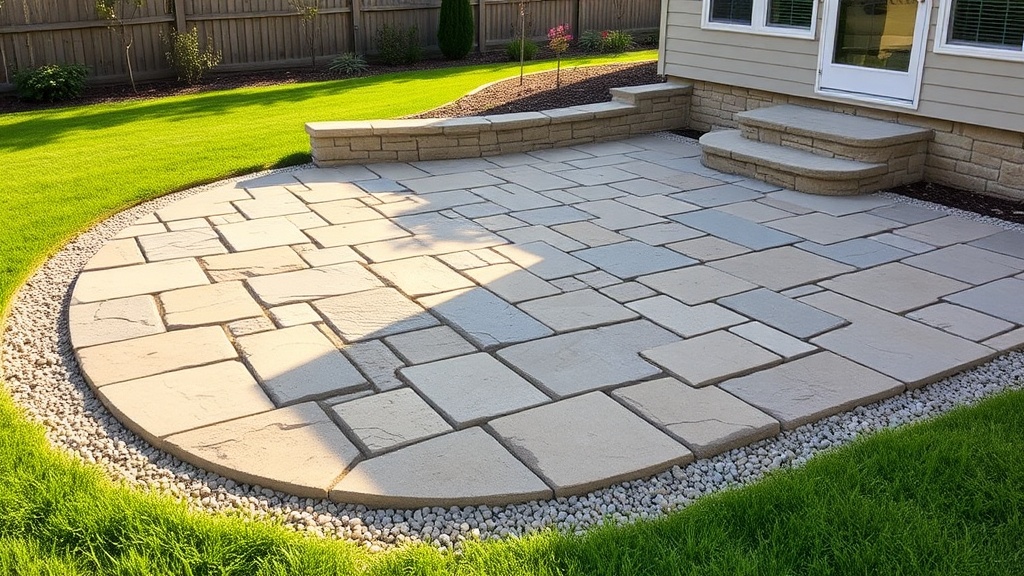
How to Lay a Flagstone Patio Without Losing Your Mind or Your Budget

How to Lay a Flagstone Patio Without Losing Your Mind or Your Budget
I get asked about patios more than almost anything else. And the question is always the same: "Travis, can I actually do this myself, or am I going to end up with a lumpy mess?"
Here's the honest answer: a flagstone patio is one of the most forgiving DIY hardscape projects you can take on. Way more forgiving than pavers, which need precise grading and edge restraints or they shift on you within a year. Flagstone is irregular by nature, so small imperfections just look like character.
I've laid flagstone for clients charging real money, and I've helped neighbors do it on a weekend for under $500. The process is the same. The difference is just scale and stone quality.
Why flagstone over pavers or poured concrete
Three reasons I steer most suburban homeowners toward flagstone for their first patio project:
- No forms, no mixing, no curing time. Concrete is permanent and unforgiving. One bad pour and you're staring at it for a decade or paying someone to jackhammer it out.
- No edge restraints needed. Pavers require a border system or they migrate. Flagstone sits on a compacted base and stays put because each piece weighs 40 to 80 pounds.
- Natural look that ages well. Pavers start looking dated after five or six years. Flagstone looks better with moss, weathering, and time. Ten years from now it'll blend into your yard like it's been there forever.
The tradeoff is that flagstone is heavier to work with and the surface isn't perfectly flat. If you need a spot for a dining table with wobbly legs, pavers are the better call. But for a grill area, a seating circle, or a walkway landing — flagstone wins every time.
Materials: what you actually need and what you don't
Here's my standard materials list for a 10x10-foot flagstone patio. This is the size I recommend for a first project — big enough to be useful, small enough to finish in a weekend.
- Flagstone: About 1 ton for 100 square feet. Expect to pay $300 to $500 depending on your region and stone type. I like Pennsylvania bluestone for the Raleigh area, but Tennessee fieldstone works too if you want warmer tones.
- Crushed gravel (¾-inch): About 1 cubic yard for the base. Around $40 to $60 delivered.
- Stone dust or decomposed granite: Half a cubic yard for the setting bed. $25 to $40.
- Landscape fabric: One roll. $15.
- Polymeric sand: Two bags for joints. $25 each.
What you don't need: a plate compactor (a hand tamper works fine for this size), special sealers (flagstone doesn't need sealing for years), or a landscape architect (you're laying rocks on crushed gravel, not designing a cathedral).
The base is everything — don't skip this part
I've torn out more failed patios than I've built new ones, and the failure is always the base. Always. The stone is fine. The layout is fine. The homeowner just set flagstone on top of dirt and hoped for the best.
Here's how to build a base that actually works:
- Excavate 6 inches deep. Mark your area with stakes and string. Dig out the soil to a consistent depth. You want the finished surface roughly level with the surrounding yard or just slightly above it.
- Grade for drainage. Slope the excavation away from your house at about 1 inch per 4 feet. Not steep enough to notice, but enough that water moves off the stone instead of pooling.
- Lay landscape fabric. This keeps soil from migrating up into your gravel base over time. Overlap the edges by 6 inches.
- Add 4 inches of crushed gravel. Spread it in two 2-inch lifts. Tamp each lift with a hand tamper until it feels solid under your boots. This is the boring part. Do it anyway.
- Add 1 inch of stone dust. This is your setting bed — the layer you'll press the flagstone into. Screed it flat with a straight 2x4.
Total base depth: 5 inches of compacted material under each stone. That's it. This holds up in freeze-thaw climates, clay soil, and everything in between.
Laying the stone: the part everyone overthinks
People watch too many YouTube videos about flagstone and psych themselves out. Here's the reality: you're fitting puzzle pieces. That's it.
- Dry-lay everything first. Spread your stones out on the lawn next to the patio area. Look at the shapes. Start fitting them together like a jigsaw puzzle, starting from one corner and working out. Leave joints of ½ to 1 inch between stones.
- Cut only when you have to. A diamond blade on an angle grinder handles flagstone easily, but every cut is a chance to crack a piece. Most flagstone patios need fewer than 10 cuts if you're patient with the layout.
- Set each stone by pressing and twisting. Lift one piece at a time from your dry layout, set it on the stone dust, and press it down with a twist. Check it with a level. If it rocks, pull it up, add or remove stone dust underneath, and reset it.
- Keep a rubber mallet handy. Light taps to seat a stone evenly. Don't whale on it — flagstone splits if you hit it too hard.
- Check level every 3 to 4 stones. You're not building a pool table here, but you want it close. A 4-foot level across multiple stones should show your drainage slope and not much else.
The whole layout and setting process for a 10x10 takes about 4 to 5 hours for one person. Two people cut that in half because one can be fitting pieces while the other sets and levels.
Filling joints: polymeric sand is your friend
Once all your stones are set and level, sweep polymeric sand into the joints. This stuff hardens when you mist it with water and locks everything together. It also keeps weeds from growing between the stones, which is the number one complaint I hear from people who used regular sand or left their joints empty.
Tips that save you from redoing this step:
- Sweep the sand in dry. Push it into every joint with a broom until they're full.
- Blow or sweep ALL excess off the stone surfaces before wetting. Polymeric sand that cures on the face of your flagstone leaves a haze that's annoying to remove.
- Mist — don't hose. A gentle shower setting for about 30 seconds per section. You want to saturate the joints without washing the sand out.
- Stay off it for 24 hours. I know it's tempting. Leave it alone.
Real cost breakdown for a 10x10 patio
Here's what I'd budget in 2026:
- Flagstone: $350 to $500
- Crushed gravel: $50
- Stone dust: $35
- Landscape fabric: $15
- Polymeric sand: $50
- Stakes and string: $10 (if you don't already own them)
Total: $510 to $660
Compare that to hiring a contractor for the same 100 square feet: you're looking at $2,000 to $3,500 installed, depending on your market. So you're saving $1,500 minimum by doing it yourself, and the skills transfer directly to any future project — paths, fire pit pads, stepping stone runs.
Mistakes I see over and over
After seven years of contracting and way too many patio teardowns, these are the recurring failures:
- No base, or a too-thin base. Three inches of gravel is not enough. You need four, compacted in lifts. I don't care what the guy at the stone yard told you.
- Setting on sand alone. Sand without gravel underneath shifts and settles unevenly. You'll have rocking stones within one season.
- Choosing stones that are too thin. Flagstone under 1.5 inches thick cracks under foot traffic. Ask for 1.5 to 2-inch material. It costs a bit more per ton but you won't be replacing pieces in year two.
- Skipping the drainage slope. Flat patios pool water. Pooling water grows algae. Algae makes flagstone slippery. Someone falls. Don't be that guy.
- Rushing the polymeric sand. If you hose it instead of misting, or walk on it before it cures, you'll be buying two more bags and doing the joints again.
My honest take
A flagstone patio is probably the best first hardscape project for a homeowner who has basic tools and a free weekend. The materials are affordable, the process is logical, and the result looks like something a professional installed — because the technique is the same whether you're charging for it or not.
If you've been staring at a bare patch of grass behind your house wondering what to do with it, stop scrolling Pinterest and go price some stone at your local landscape supply yard. You'll be surprised how affordable it is, and I guarantee you'll be more satisfied with something you built yourself than anything you could order off a website.
Got questions about your specific yard? Drop a comment and I'll tell you what I'd do.